Ronald Cohen, Venture Capitalism & Social Innovation
At a recent company-organized speaker event, I had the pleasure of listening to Rohen Cohen‘s speech on a wide range of topics, starting from his own career as an entrepreneur in the world of venture capital (back in the days when the concept barely existed) right after his Harvard MBA, his three pointers on success as entrepreneur and finally, how he is using his experience and skills from the world of venture capital to apply it to areas of social innovation. Following the talk, I immensely enjoyed being part of the small crowd surrounding Ronald as he dispensed quick tips, advice and revealed some personal quirks.
He talked of his own experience, freshly out of HBS back in the late 60’s and early 70’s when Intel was set up and companies were launching IPOs. His journey of establising Apax as a successful venture capital fund was revealing of all the stumbling blocks a startup must expect to face and it was interesting how he surmounted them. Listening to his glib narration of how they grew into a business handling over 35billion USD AUM belied the great battles they must have bought to get it there.
Coming from who is known as ‘the father of British venture capitalism’, his words about success in entrepreneurship certainly carried some weight – his three-point agenda was crisp and universal, applicable to those in the corporate world and to those who look to venture out to make their own mark independently. His three-pointer could be summarized as:
1) Exploiting uncertainty needs conviction but be willing to revise methodology – Not everyone will agree with you, so you must persevere (because luck is more than just chance, it’s perserverance), but do not close out options for evolving as the market gives you feedback about where you stand.
2) A business grows to the vision the entrepreneur brings to it. SIZE does matter, so plan to sustain a larger edifice. Too many people start off with their life dreams and open doors to a ‘cupboard’, rather than to the ‘boardroom’. So don’t chase small fry, plan BIG.
3) The relationship between Ego, Intellect & Intuition should be complementary. Ego can be a good thing but if you always envision yourself at the centre of the organization, then the business has to adapt to the needs of the manager, rather than to those of the market. Lead from the front – delegate decision-making, recruit talent and plan succession.
Another interesting piece of Cohen’s personal and professional history that greatly piqued me was how he exited the world of startups and business expertise after 33 years and entered the area of philanthropy and public policy making and once again, very seamlessly moved onto launch programs and implement ideas as if he had always belonged there. Apart from his work with the British Museum & Institute of Strategic Studies, his major projects include:
a) the Bridges/Ventures initiative, which is a venture fund to spur innovation and independence among classes which often fall prey to dependence on the state – the bottom 25% of society in the UK.
b) a major project on conflict resolution in Israel/Palestine through capitalistic interests. His belief that governments and the military discount the economic dimension of conflict resounded strongly with my own views on the subject. He has been in involved in various activities to develop the Palestinian private sector, most notable of which is a billion-dollar investment in housing in the West Bank. He is of the opinion that, in Europe, the closest example of the ‘Silicon Valley’ is in Israel.
Yes, it is true; contrary to what all your hippie friends and we-hate-the-mainstream-folks tell you, it is possible to be ridiculously successful in the capitalistic corporate world and transfer skills from that world to socio-political contexts to make some real difference to society.
What greatly enhanced what I expected to be only an intellectual experience was Cohen’s approachability, warmth and sense of humour, especially when surrounded by all and sundry with so many questions and requests for advice. He listed to each one with utmost attention and had to be literally dragged away over an hour of advice-dispensing later. Another testament to the fact that successful people are often what they are because of their unreal ability to relate to people.
He was also surprisingly candid and forthcoming about his personal matters, and he made a sheepish remark saying that what he gave to the business world, he took away from his personal life – in reference to his numerous marriages; he seems happy with his present wife who’s quite an achiever too, it would seem, given she is as an Oscar-awarded producer.
The purpose of this talk was to launch his book, The Second Bounce of the Ball.
—
As an aside, this talk by Cohen helped address my own cognitive dissonance about relevance to the socio-political sphere, given my day job in the corporate private sector. And for the inspiration that he provided, I hold the event in high esteem.
Dear TFL…
Transport for London is going on strike. Again. No, really. It might seem like we got past the last strike discussion just yesterday and lo behold, another one already!
I am sorry, TFL, this time you have no sympathy from anyone – if you feel like the world is being unjust only to you, wake up and smell the Earl Gray Tea – the recession, the dejectedness and pecuniary woes are universal this time, not just diabolically aimed at you. So please stop this ceaseless cycle of paralysing the city and holding it to ransom.
Update: Kudos to Northern Line & DLR staff for keeping the city in motion, even through the strike.
Imagining India & Nandan Nilekani
I left work very early Wednesday evening to rush to LSE to what I knew would be an over-subscribed event – Nandan Nilekani’s talk on his book and ideas for India for the new century. Packed in with Indian students, non-Indian faculty and myriad other folks in between, I was impressed by Nandan’s idealistic visions for India, his sense of humour, Lord Desai’s policing of the crowd and most importantly, the intelligent and pertinent questions raised by the audience.
There’s no denying that India has the potential to reap the ‘demographic dividend’ that Nandan repeatedly referred to, during his talk. But for that to happen, there has to be concerted effort on the part of aam aadmi, the intellectuals/entrepreneurs/politically aspiring youth sparring words in the LSE auditorium and many other campuses, the private sector of India, the international community and the government of India. It is not a coincidence that I place the Indian government last in that list – like Nandan, I believe that much of India’s progress, if it happens, will be irrespective of and inspite of party politics and the melee of democractically dissenting voices. That, I think, is the true strength of democracy – the ability to organically grow ideas into real benefits, with or without the support of the state, because the individual is empowered to make his choice without the need for social engineering. And yet, like many realists in the audience, we must remember that there’s a deadline to meet – as this youthful generation of India ages, the goals have to be met and the dreams fulfilled, so that a generational disaster is averted, in terms of cost of healthcare and pension.
I might be guilty, here, of saccharine doses of idealism myself, but I look forward to piecing together the puzzle of the India to come and of pondering upon the ideas that Nandan puts forward in his book – those implemented, those to executed, those in contest and those which need to be examined further.
It thrills me to see my nation evolve in my lifetime – the entry of Shashi Tharoor, Malika Sarabhai, Meera Sanyal, among others, indicates a new face of politics in India and personalities like Nandan Nilekani will, I hope, be only a precursor of a generation of personalities from the Indian private sector to make a difference to India.
Meanwhile, there were some unexpected but welcome outcomes of the event which included me running into the quirky self-styled social activist I had met a few weeks ago at the LSE Literary Weekend and meeting a grad student at LSE who plans to set up an entrepreneurial venture in the area of electronic waste management in south India – someone I expect to meet again in the near future.
Glossing over reality, again?
There has been a spate of Q1 result announcement all around the financial industry – over the past few years, this would have been an occasion for fabulous one-upmanship. This year, the tone is decidedly more mute, as each bank hopes the shareholders would quit breathing down their respective necks and that the damned market would please have more faith in the organization.
And yet, being in the industry, I feel a completely deceptive and forced air of positive outlooks on the back of suspiciously good Q1 results. Sorry to play spoilsport but might I point out that there is no wisdom in creating another bubble before the previous one has finished bursting?
Irony
The very people who are out to protest the mindless wastage of taxpayer money on what they deem to be less than deserving causes, will be responsible for a bill of over 7.5 million sterling to the exchequer. I am ALL for free speech but it’s a thin line between waxing eloquent on what you believe in and smashing into offices, killing a bystander and assault, among others. Something I read in the London Metro earlier today, it is really an irony that the first daffodils of spring were trampled on by environmentalists.
I wonder on what grounds they will now find a way to express this as an act of self-righteousness!
A Hairy Situation
In spite of my initial idea that my issue-based blog would be separate from my personal life, it is perhaps inevitable that my personal experiences are mentioned here. What we understand of the world is, after all, is an amalgamated set of personal observations and value systems, shaped by the mundanities of our lives.
–
‘There’s more to life than just hair, but it’s a good place to start’ – The Aussie Philosophy
Growing up, I had always been identified among various circles as the ‘curly-haired one’. As a child and then as a teenager, all the way till my first year in college, I always maintained a close crop of hair, because of the inherent difficulty in maintaing long, curly tresses. I accompanied my mom to the quintessentially Indian ‘beauty parlours’, run by Punjabi ladies, if not taken along with Dad to the local barber salon or have the military barber wield his tools most efficiently on my dad, my bro and then me. Mostly, it fitted well with my one-of-the-boys image so I didn’t mind but as I entered my late teens, I resented my parents’ insistence on what was then unfashionably called, ‘the boy cut’.
As I entered my late teens and moved to Singapore, I finally gave fruition to my desire to grow my hair out, only to be faced with daily frustration and despair with hair that, literally, seemed to have a mind of its own. My stubbornly unkempt hair became a source of endless amusement for friends and a fabulous source of jokes for my self-deprecating sense of humour.
‘Some people have bad hair days. I have a bad hair life.’
‘I always look like I have just had an electric shock – suits my charged up personality.’
‘Who needs dishwashers? My hair is naturally coarse and thick, like the coconut fibres used to scrub vessels in some parts of India.’
‘I’m a born nature lover – my hair makes for fabulous birds nests.’
Indeed, my hair became so central to my personality that even after a decade of not having seen me, friends would scan crowds for curly-haired girls, when looking for me. Whenever I parted ways with friends and rued the possibility of things changing, people would express fear that I would change fundamentally, and how my new personality would have straight hair.
In my tentative forays into femininity, sometime in the final year of high school in Singapore as an eternally broke student, I decided to stop waiting to head back to India for haircuts and to splurge a bit in the decidedly more expensive but seemingly more sophisticated hair salons in Singapore. And this is when my hair started becoming something bigger than myself, something akin to the colour of my skin, something I had never been self-conscious about until I had stepped into the ‘multicultural’ realm of Singapore, only to be hurled racist insults by people who deemed themselves superior to my brown-skinned self by virtue of their somewhat more fashionable yellow-tinged epidermis.
“Too curly. Too messy. Troublesome. Needs to be straightened. You should rebond your hair, you know? It will make it straight and beautiful. This Indian hair, ah, not good, leh. Must treat it – we can do it for you, do you have time now?”
Hailing from the pre-2000 India where my middle-class sensibilities had not exposed me to the wonders of hair extensions, rebonding and myriad chemical treatments which are so ubiquitous today, I declined any such offers. “Just a trim, please, or if you could layer it up to de-volumize my hair? Thank you.”
Moving on to college life, I noticed increasingly that my Indian batchmates and seniors instantly upped their hotness on campus by rebonding their hair. It seemed as if the only way to earn the prized tag of ‘beautiful’ was to adopt the local template – rod-straight hair and stick-thin bodies, coincidentally also characteristics of most Chinese girls in Singapore.
At every hair salon, it always played like a script and always had the grating quality on my nerves which other beauty tips did not. Perhaps, it was because straight hair was the natural prerogative of the Chinese race or that the idea of beauty was modeled after the majority race, I started taking these tips rather personally even though I learnt to shrug off such suggestion with quips on how I like the character of my curly hair and how I did not want to look like a carbon copy of just about everyone else. It was sometime in my second year of college that I finally gave up on Singapore hair salons – they seemed to have an inherent issue with the Indian texture of my hair and I did not want to change myself, so it was a no-go situation.
I wore my mad, unkempt hair as my badge of honour, my symbol of pride in my race. I fought with it daily, gave up on it, shed tears over it but refused to straighten it. At various points, I wondered if I was going overboard in ‘racializing’ a non-issue – most others were not overly bothered by what I sensed to be a constant undercurrent of racism and hostility which, admittedly, has toned down over the years in Singapore as Indians have grown to be an economic force to reckon with. But I do remember flinching when I heard someone call curly hair ‘unprofessional’ – right, so now you can deny me promotion because my hair doesn’t fit into your blueprint for perfection?
It is hard to summzarize the complex relationship between physical appearances, race and politics, but has it not always been the case that our physical likeness, along with what we wear and show of ourselves, is a symbol of our political being? I remember a Palestinian friend wore old Palestinian coins as earrings to assert her political identity. Sikhs have been singled out and persecuted, identified clearly by the turban they choose to wear. Under the Nazi regime, Jewish physical characteristics were identified to pick out people and persecute them. I felt an immense sense of validation when Obama, in his book, Dreams from my Father, expresses disappointment at one of his female black classmates wearing green contact lenses – he felt saddened that women of his race felt the need to mask their natural characteristics to feel beautiful. Watch an excellent documentary on African-American women’s dichotomy of beauty vs what they are naturally and how even kindergarten kids define good and bad by the colour of the skin of their dolls.
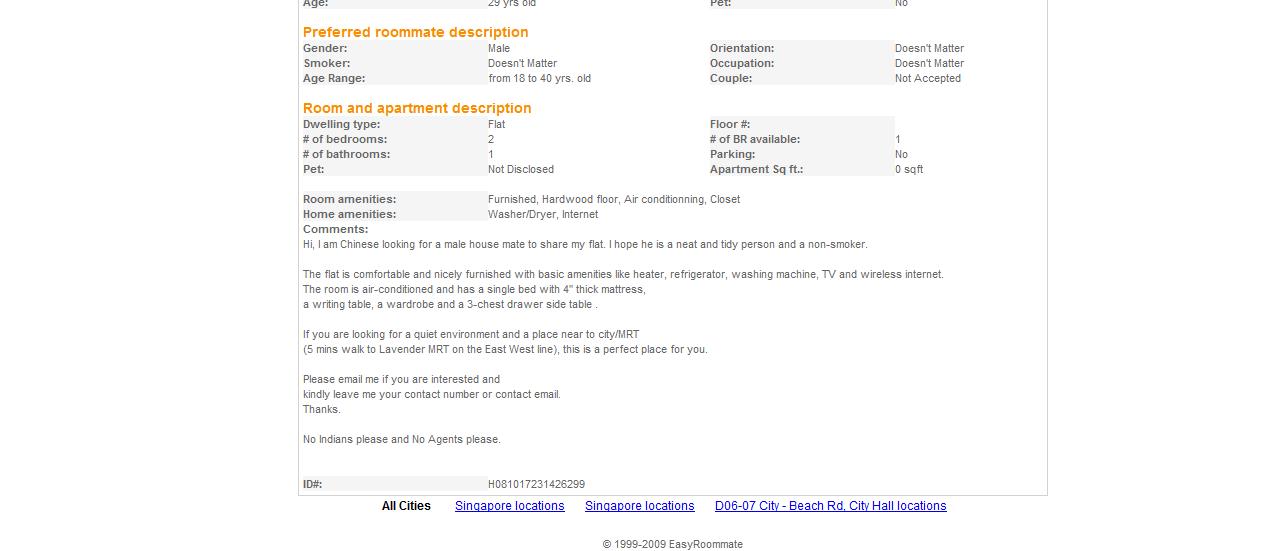
Recently, I discovered the wonders of the GHD flat-iron straighteners and even while enjoying the convenience of tangle-free, bouncy hair, I grappled greatly with the idea of letting go of an old ideal. Before I bought my straightener, I introspected and agonized for a month on whether I was selling out after all, if I was giving up the ‘fight’ as a lost cause, by toeing the party line, so to speak. I even actively resented the enthusiasm with which my friends welcomed my straight-hair look, as if they hadn’t liked my erstwhile curly look. But I now live in London, and I am merely fighting ghosts from the past by stubbornly standing by my unmanageable hair. At some point, I reconciled myself to the fact that if I stopped fighting my hair, I could start fighting the system which allows even blatant racism. Yes, the same system which allows room-for-rent ads in which the closing line reads – ‘No Indians, please.’ (Ad now taken down, screenshot here)
–
Thanks to Aman for the room-for-rent link which inspired me to come back and complete this post. It’s easy to dismiss this antagonism I held over the years as some sort of teenage angst or resentment at my own looks, but there’s no two ways about that ad – if you’re Indian, beautiful or not, straight-haired or not, you’re not welcome. And for the record, I do love my curly hair. Just that on some days, a little bit of coaxing by a straightener makes it easier to handle 😉
Why I am not the biggest proponent of generous social benefits
…can be summed up in the sheer WTF factor in this.
That the participants in such preposterous situations are actively encouraged by their parents to continue such behaviour can only be explained by this fact – tax payers are willing to bend over their backs and indulge such whims. As the crisis unfolds, people lose jobs and tax revenue dips, surely an abundance of 13-year-old dads is an avoidable trap for the nation?
Hello, we meet again…
I am not new to the world of blogging. In fact, I am as old as one gets as a blogger within my own social circle, which might not be saying much. And yet, I can hardly boast of the web presence of those who’ve been ‘around’ for this long in blog-dom. This was a deliberate exercise in effacing myself from the public domain, for I maintained a personal blog. As a window into my personality, my vulnerabilities and my quirks, I chose to share it strictly among friends and shunned unwelcome company, especially if they happened to be folks I know in the real world but not in a terribly intimate manner.
Over the past few years, I’ve been drawn increasingly to the idea of issue-based blogging, rather than merely personal or topical blogging. This blog would be open to debates and discussions and readership by all. I kept myself in a quagmire, trying to figure out whether to set up my own domain (which remains sadly neglected) or whether to combine issue-based blogging into my personal journal – but I didn’t want not-so-close friends to be updated on the nitty-gritties of my life. Amidst all this vacillation, many years went by and many passionate posts full of opinions and debate points never saw the light of day. I have now finally decided to do something that is bound to be very tough – maintaining this blog where I can write about things beyond myself while also writing up my personal journal to keep my friends posted of my whereabouts and exploits.
And thusly, here goes nothing…

 Potpourri